In this article
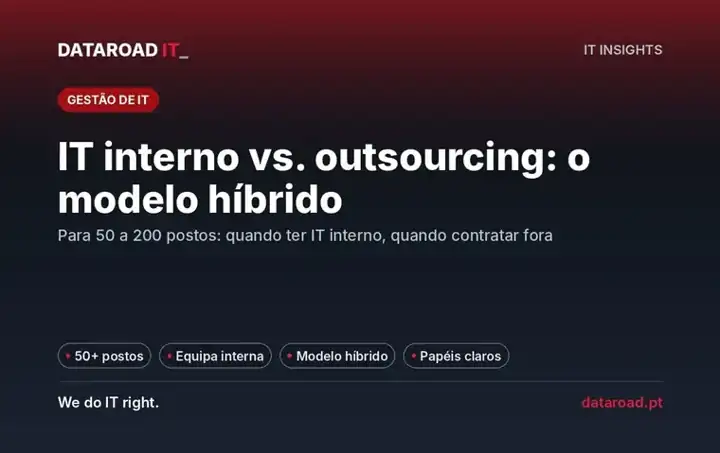
For a company of 50 to 200 workstations, the IT model we most often see working is co-managed: an in-house IT lead who decides and coordinates, and a premium MSP that runs, monitors and protects the infrastructure. A 100% in-house department becomes expensive and fragile before it reaches scale; outsourcing with nobody on the inside loses touch with the business. This guide shows the sums, the division of roles and the conditions for the model to work.
If your company has 20 or 30 workstations and the question is whether to hire a technician, the sums are in in-house technician or managed services for 30 workstations.
What changes from 50 workstations upwards
Up to 30 or 40 workstations, a technician or a retainer covers the essentials. After that, IT gains layers: more offices or remote teams, more business applications, demands from clients and auditors, tighter security. In certain sectors, the NIS2 directive now requires cybersecurity measures and management accountability.
There are also decisions that can no longer be taken from outside: which software to buy, how to integrate an acquisition, how to allocate the budget. This is where the temptation to build a full department arises.
What an MSP is: a Managed Service Provider is a company that manages your IT on an ongoing basis, under contract and for a monthly fee — support, monitoring, security and backups — instead of turning up only when something breaks.
What it costs to build everything in-house
To serve 100 workstations well, an in-house department needs at least:
- Service desk Day-to-day user support.
- Infrastructure Networks, servers and cloud.
- Security Firewall, device protection, access management and incident response.
- Coordination Someone to plan, manage suppliers and talk to the board.
One person doing it all is a single point of failure. Two people leave one alone whenever the other is on holiday. Using the assumptions in our example, each technician costs between €30,300 and €40,700 a year, and a minimum team of three exceeds €90,000 — before monitoring, security, backup and ticketing tools, and without out-of-hours cover, which a small team cannot guarantee without shifts.
Who does what in the co-managed model
The company hires one person — the IT lead — and hands the technical operation to the MSP. That person is not “the technician who fixes everything”: they know the business, set priorities and make sure the partner delivers. It is the shared IT department model that DataRoad proposes to companies of this size.
| Area | In-house lead | MSP (DataRoad) |
|---|---|---|
| Strategy and budget | Decides with the board | Proposes, using data from the estate |
| ERP, CRM and sector software | Manages the vendor and key users | Maintains the infrastructure they run on |
| Joiners and leavers | Requests and approves | Creates accounts, devices and access |
| User support | First in-person contact, when useful | Remote, on-site and telephone service desk |
| Networks, Wi-Fi and firewall | Validates changes | Manages, updates and monitors |
| Servers, cloud and Microsoft 365 | Sets policies | Administers and maintains |
| Backups | Approves the plan and follows tests | Runs, tests and reports |
| Security and incidents | Communicates with management | Protects, detects and responds |
| Monitoring | Receives reports | Continuous; 24/7 on Premium 365 |
| Holidays and absences | — | Operations continue |
Three models, three contexts
- 100% in-house Several hundred workstations, highly specific in-house systems or permanent technical presence in shifts, with a budget for a full team.
- Co-managed 50 to 200 workstations, significant business applications and the need for someone inside who speaks management’s language, without paying for an entire team.
- 100% MSP No complex internal applications, with a preference for a single external point of contact and a fixed cost. It also works above 50 workstations, with regular meetings with the board.
DataRoad IT Unlimited
Talk to DataRoad. We assess your operation and propose the right plan.
Five rules for the model to work
- Responsibilities in writing — the division in the table above must be in the contract.
- A single ticketing system — shared by the in-house lead and the MSP, so nothing gets lost in emails.
- Company documentation — inventory, network diagram, access and backup policy always kept up to date.
- Regular meetings with KPIs — tickets, response times, incidents, projects and alerts from the NOC and monitoring.
- Real authority — the in-house lead makes decisions and has a direct line to the board.
DataRoad’s IT Unlimited includes managed cybersecurity — firewalls, probes, device protection, 2FA/MFA and monitoring with alerting. For operations that cannot stop at night or at weekends, Premium 365 (from €1,200/month + VAT) adds nights, weekends and public holidays and is the only plan with 24/7 support and monitoring. Annual contract, automatic renewal, 60 days’ notice and no lock-in.
A real case: Velv by OnRising, around 200 workstations
Velv by OnRising, a nearshore software development company with offices in Porto, Lisbon and Rio de Janeiro, extended its IT Unlimited contract with DataRoad to around 200 workstations.
The scope shows what a company of this size takes off its own hands: service desk, management of firewalls and network security, wireless network administration, support for servers, cloud, printing and internet, preventive and corrective maintenance, and 24/7 monitoring with alerts and reports on the Premium 365 plan. See the Velv by OnRising case study.
Frequently asked questions
At how many workstations does an IT department pay off?
There is no fixed number, but between 50 and 200 workstations most companies benefit from an in-house lead combined with an MSP. A fully in-house department is only justified with enough scale for several specialisms and holiday cover.
What is the role of the IT lead in the co-managed model?
They set priorities with the board, manage the budget and business software vendors, approve changes and oversee the MSP. The technical operation — support, networks, servers, security and backups — stays with the partner.
Is it risky to move from an in-house department to this model?
Not if the transition is planned: an infrastructure survey, documentation, handover of access and a period running in parallel. Knowledge becomes documented rather than concentrated in people.
Does DataRoad provide support outside office hours?
Yes, on the IT Unlimited Premium 365 plan, with nights, weekends and public holidays, and 24/7 support and monitoring.
Next step: your IT model in 10 working days
We analyse the infrastructure and the team and deliver a division of responsibilities — what stays in-house, what moves to the MSP — with a fixed IT Unlimited proposal, with no obligation.
More than 10 workstations · support contract · remote, on-site and telephone support. Call +351 211 459 950* or write to sales@dataroad.pt.
*Call to a Portuguese landline.