In this article
Proactive monitoring means continuously measuring the state of every component of the infrastructure and acting when a threshold is crossed, before anyone feels the failure. Reactive support does the opposite: it acts after the problem has brought the company to a halt. The cost of the difference almost never appears on the provider's invoice; it appears in the hours the team spent unable to work.
An example: a full server disk can be discovered at nine in the morning, when email stops working, or ten days earlier, when an alert warns that it is about to reach its limit and someone frees up space without anyone noticing.
Three incidents, two outcomes
| Incident | Reactive model | With a NOC and monitoring |
|---|---|---|
| File server disk filling up | At 9:12 on a Tuesday the server stops saving; accounts cannot export; the technician calls at 10:30 and frees up space at 11:00. Two hours with 20 people idle. | Warning at 80% twelve days in advance, automatic ticket, space freed overnight. Nobody noticed. |
| Backup failing | Three weeks without anyone noticing; when the server fails, the last good copy is 21 days old. | Alert on the first night, fixed the next day. The longest backup gap ever recorded: 24 hours. |
| Intermittent Wi-Fi access point | Months of vague complaints about “slow internet”, never linked to the device. | The dashboard shows the same access point dropping 40 times a day; it is replaced and the complaints stop. |
Why the reactive model still dominates
It is easy to buy: when something breaks, someone fixes it. It requires nothing to be installed and generates no alerts. That is why it remains the norm in many Portuguese SMEs.
The problem is that most of the incidents we deal with at companies that do not yet have a managed service gave warning signs days in advance. A disk does not fill up in a second, a network device does not suddenly start failing, and a backup that fails one night fails on the following nights too. With nobody watching, the signal is lost.
What a NOC measures in an SME
Each metric has a threshold and each alert a severity — warning, important or critical — which determines who is notified and through which channel.
- Servers Disk space and health (SMART, RAID), CPU, memory, essential services, temperature and power supplies.
- Network Availability of switches, access points and firewall, port errors and link saturation.
- Internet Main line and redundancy, latency and operator outages.
- Backups Completed or failed, abnormal size and run time.
- Workstations Pending updates, outdated antivirus and devices that have stopped reporting.
- Deadlines Certificates, domains and licences about to expire.
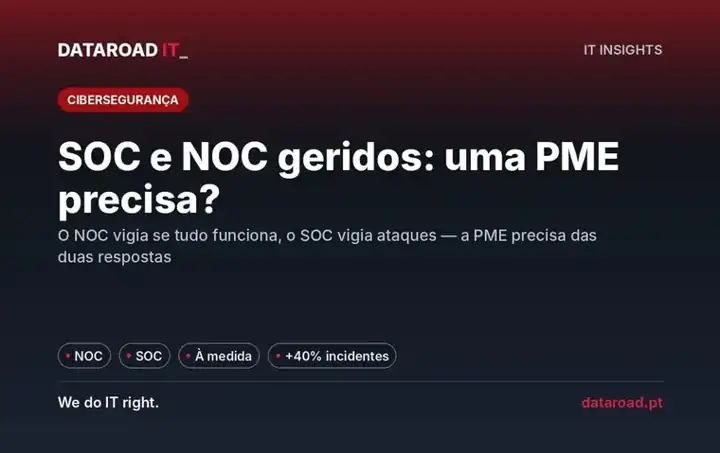
At DataRoad the platform is Zabbix, with Grafana dashboards, and each client sees the dashboards for its own estate. Service details are on the NOC and IT monitoring page, with 24/7 oversight in the Premium 365 plan.
An installed tool is not a service delivered
Many companies already have a monitoring tool sending emails to an inbox nobody opens. That is noise. An alert only becomes prevention when someone sees it, opens a ticket, intervenes and leaves a record.
That is the difference between a piece of software and a NOC: an operations centre with a team, escalation and severities tuned for each client. In IT Unlimited contracts, monitoring is not an extra: it is what makes it possible to offer unlimited support without living from one emergency to the next.
DataRoad IT Unlimited
Talk to DataRoad. We assess your operation and propose the right plan.
The limits of monitoring
Monitoring does not stop a disk from failing without warning, nor an operator from cutting the line. It ensures that the failure is detected immediately, that the response starts straight away and that there is a record. Nor does it replace backups or a disaster recovery and continuity plan: they are three distinct layers, and a serious contract includes all of them.
How to move from reactive to proactive
- Assessment — identify what is critical in the estate.
- Installation — agents and probes, within a few days.
- Tuning — two to three weeks to adjust thresholds and eliminate false alarms.
- Operation — a monthly report on the state of the estate, with recommendations.
The team does not change the way it works. It simply decides it would rather know in advance.
Frequently asked questions
Does monitoring replace antivirus?
No. Antivirus protects a workstation against malicious software; monitoring measures the state of all devices and services and warns when something falls outside the norm. They are complementary layers.
How long until it is stable?
Installation takes a few days and tuning two to three weeks. After a month it is stable and the first report is delivered.
Does monitoring access our files?
No. It collects technical metrics — space, load, availability, errors — without access to files, emails or databases.
Is it worthwhile for a company that closes at 6 pm?
Yes. Night-time alerts are logged and dealt with in the morning, before the team arrives. Intervention at night, at weekends and on public holidays is only part of Premium 365.
Next step: see what your infrastructure is doing right now
We carry out a no-commitment assessment and show you what a NOC would detect in your estate today. More than 10 workstations · support contract · remote, on-site and telephone support.
Phone: +351 211 459 950* · Email: sales@dataroad.pt
*Call to a Portuguese landline.